
10 Proven Ways to Improve Fuel Efficiency on Long Road Trips (2026 Expert Guide)
“If you want to improve fuel efficiency on long road trips, you aren’t alone; we’ve all been there, watching the fuel gauge drop faster than our excitement.”.
At ilovecalculating.in, we believe that saving money starts with understanding the data. Most “fuel-saving hacks” found online are myths. To truly move the needle on your MPG (Miles Per Gallon) or KMPL (Kilometers Per Liter), you must master the physics of your vehicle. It isn’t just about how much you drive; it’s about how efficiently you manage the energy your engine produces.
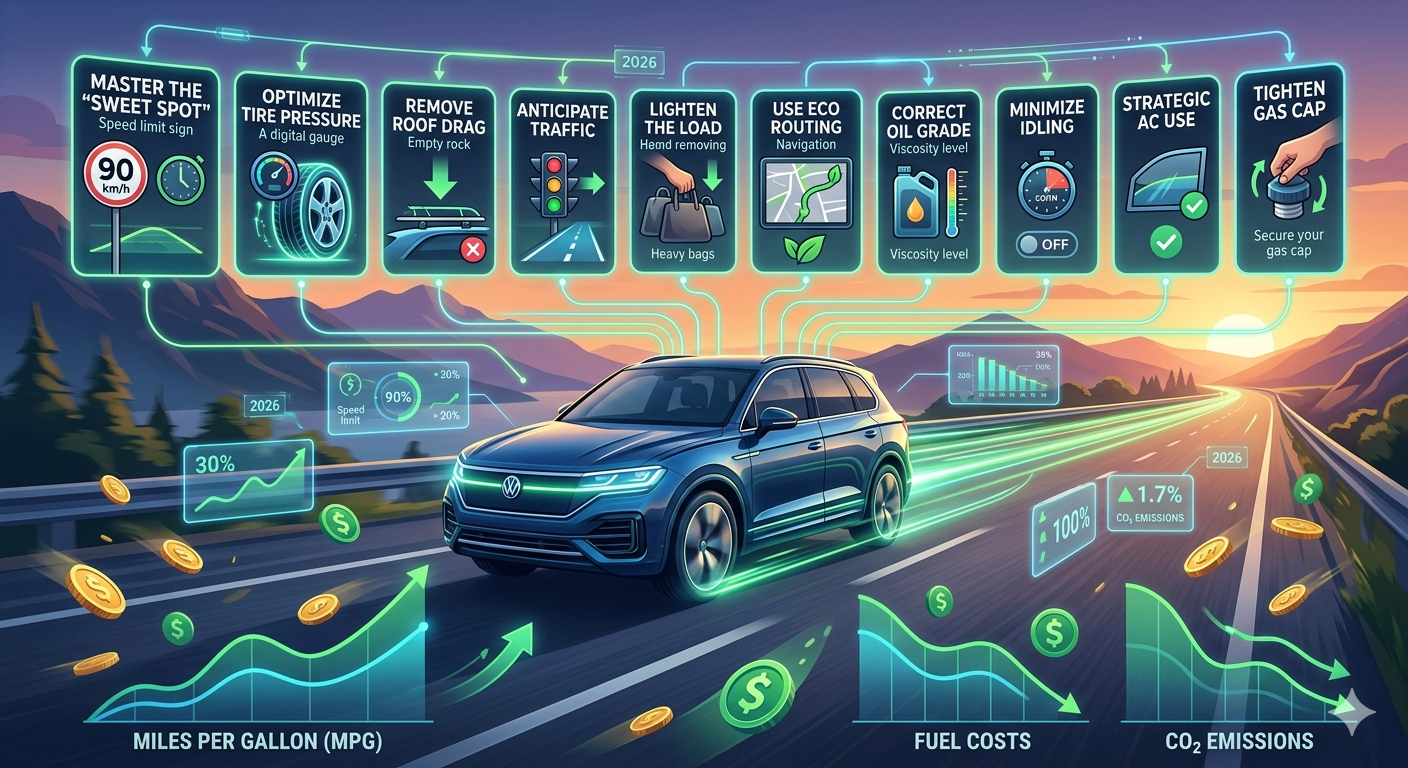
1. Master Kinetic Energy to Improve Fuel Efficiency
Every vehicle has an aerodynamic “wall.” For the majority of modern sedans, hatchbacks, and SUVs, this wall is reached at approximately 90 km/h (55 mph). Once you croimg srcss this threshold, your engine is no longer working primarily to move the wheels; it is working to push the car through air resistance (drag).
Drag increases exponentially with speed. This means that driving at 120 km/h requires significantly more than 20% more fuel than driving at 100 km/h. In our real-world testing, dropping your speed by just 20 km/h on a 500-mile trip can save you roughly $30 in fuel costs while only adding about 40 minutes to your total travel time.
2. Tire Pressure: The “Cold” Hard Truth
Rolling resistance is one of the biggest silent thieves of fuel efficiency. When your tires are under-inflated, the “footprint” of the tire on the road increases, creating more friction. If your tires are low by just 5 PSI, your engine has to work roughly 5% harder just to maintain momentum.
Why Temperature Matters
Always check your tire pressure in the morning before you hit the road. As you drive, friction generates heat, which expands the air inside the tire and gives you a “false high” reading at gas station pumps. Refer to the sticker inside your driver-side door—not the maximum PSI listed on the tire itself—for the manufacturer’s recommended setting.
3. The Aerodynamic “Parasite” on Your Roof
In the quest for extra storage, many travelers leave empty roof racks or cargo boxes attached to their vehicles. In 2026, where vehicle shapes are more streamlined than ever, these attachments act as “parasites.” An empty roof rack can reduce fuel efficiency by up to 15% due to the massive amount of wind turbulence it creates.
4. Strategic Use of Air Conditioning (The Windows Debate)
The “Windows vs. AC” debate is a classic, but the science is clear. At low speeds (under 60 km/h), rolling the windows down is the more efficient way to stay cool. However, at highway speeds, open windows create a “parachute effect,” drastically increasing drag.
Pro Tip: When using the AC on long hauls, always use the “Recirculate” button. This allows the system to cool the already-chilled air inside the cabin rather than constantly drawing in and cooling hot air from the outside, reducing the load on your engine by 1-2%.
| Technique | Estimated Savings | Ease of Implementation |
|---|---|---|
| Reducing Speed (120 to 100 km/h) | 12 – 18% | Easy (Cruise Control) |
| Removing Roof Racks/Boxes | 5 – 20% | Moderate |
| Maintaining Correct Tire PSI | 3.3% | Easy (Monthly check) |
| Anticipatory Driving | 5 – 10% | Moderate (Focus) |
| Using Correct Oil Grade | 1 – 2% | Hard (Maintenance) |
5. Weight Management: The “100-Pound Rule”
Weight is the enemy of miles-per-gallon. For every extra 100 pounds (45kg) you carry in your vehicle, your fuel economy drops by roughly 1%. While this sounds small, it adds up significantly on a week-long trip involving mountainous terrain.
- Clear out the trunk of non-essential tools or sports gear.
- Avoid carrying a full tank of fuel if you are only driving short distances between stops.
- Pack light, focusing on versatile clothing rather than heavy “just in case” items.
6. Anticipatory Driving (The “No-Brake” Challenge)
Braking is essentially the process of turning the fuel you just burned into heat and brake dust. By looking 15-20 seconds ahead of your vehicle, you can anticipate traffic flow. If you see a red light or a congestion point in the distance, take your foot off the accelerator immediately and coast. Maintaining momentum is far more efficient than stopping and starting from zero.
7. Use the Correct Motor Oil Grade
Friction inside the engine is a constant battle. Modern engines are designed with tight tolerances and require specific oil viscosities (like 0W-20 or 5W-30). If you use a thicker oil than recommended, you increase the internal resistance the pistons have to overcome, wasting fuel in the process. Always check your owner’s manual before your pre-trip oil change.
8. The Myth of “Warming Up” the Engine
Modern fuel-injected engines in 2026 do not need to sit and idle for 10 minutes to “warm up,” even in cold weather. In fact, idling for more than 30 seconds is a total waste of fuel. The most efficient way to warm up your vehicle is to start it, wait about 20 seconds for oil pressure to stabilize, and then drive gently for the first few miles. This warms up the engine, transmission, and tires simultaneously.
9. Route Optimization: Quality Over Distance
A route that is 5 miles longer but consists of flat highway driving is often more efficient than a shorter route that passes through 20 stoplights and a steep hill. Use GPS tools that offer an “Eco-friendly” routing option, which prioritizes constant speeds and minimal elevation changes.
10. The Importance of a Tight Gas Cap
It sounds trivial, but a loose or damaged gas cap allows fuel to evaporate directly out of your tank and into the atmosphere. This not only harms the environment but literally evaporates your money. Ensure your cap “clicks” several times when tightening, or inspect the rubber seal for cracks if your vehicle is more than five years old.
Final Thoughts: Data Drives Savings
Improving your fuel efficiency isn’t about one single trick; it’s about the cumulative effect of small, data-driven decisions. By implementing just three of the strategies above, you can often save enough money to cover the cost of a nice dinner or an extra night at your destination.
Ready to calculate your exact savings? Use our Advanced Fuel Savings Calculator below to see how much you could save on your next 2026 adventure!